Welcome

This is an attempt to document my efforts to grow and eat locally around Melbourne, Derbyshire. My family own a nine acre smallholding on which we grow fruit and vegetables and keep bees, and chickens, but that won't feed us alone, so the idea is to get to know our local produce and to see how easy/hard it is to follow a diet that is local to within 30 miles. The fun part is also trying some new (easy) recipes that use home-grown and local produce. Feel free to comment, send in recipes, and share your experiences of buying and eating locally.
Showing posts with label Preserves. Show all posts

Sunday, 27 January 2013

Home-made yogurt in the AGA


Home Made Yoghurt in the AGA
- thank you to Helen B for this recipe.

This is a recipe designed for an AGA, but it should in principle work just as well in a slow cooker or the airing cupboard!

1 tablespoon natural yoghurt

1 tablespoon dried milk

1 pint (600ml) sterilised milk*

Cream together the natural yoghurt and dried milk with a little of the cold milk. Heat the remaining milk in a saucepan to blood temperature. Pour the warmed milk onto the yoghurt mix and stir to combine.

Cover the bowl with a plate, then a tea cosy or towel.

If you have an AGA stand in a colander on top of the simmering plate and leave overnight to set. Next day transfer to the refrigerator to cool.

If using a slow cooker the low setting should work. Airing cupboards may require some experimentation.

Use to make a yoghurt sundae. Spoon fruit puree, coulis or honey into the base of a sundae glass, cover with a layer of home- made yoghurt, and top generously with granola** or muesli.


*Your milkman will deliver sterilised milk on request or it can be readily found in the milk section of your local supermarket.

**Jordan’s granola is especially good for this.

Thursday, 25 October 2012

Mincemeat

This is a Delia recipe. The majority of the ingredients sadly are not local but the apples are my own Bramleys. This is so easy to make.  I doubled the recipe to make the two kilner jars shown above, but it's no harder to make double the quantity than to make a single quantity. 


 Makes 3 lb (1.35 kg)


You will also need 3 x 1lb (350ml) preserving jars and 3 waxed discs.

This recipe is adapted from Delia Smith’s Christmas.

Method

All you do is combine all the ingredients, except for the brandy, in a large mixing bowl, stirring them and mixing them together very thoroughly indeed. Then cover the bowl with a clean cloth and leave the mixture in a cool place overnight or for 12 hours, so the flavours have a chance to mingle and develop. After that pre-heat the oven to gas mark ¼, 225°F (120°C). Cover the bowl loosely with foil and place it in the oven for 3 hours, then remove the bowl from the oven. Don't worry about the appearance of the mincemeat, which will look positively swimming in fat. This is how it should look. As it cools, stir it from time to time; the fat will coagulate and, instead of it being in tiny shreds, it will encase all the other ingredients.

When the mincemeat is quite cold, stir well again, adding the brandy. Pack in jars that have been sterilised (see below). When filled, cover with waxed discs and seal. The mincemeat will keep for ages in a cool, dark cupboard but I think it is best eaten within a year of making.

NOTE: To sterilise jars, wash the jars and lids in warm soapy water, rinse well, then dry thoroughly with a clean tea cloth, place them on a baking tray and pop into a medium oven, gas mark 4, 350F, 180C, for 5 minutes.

Friday, 13 July 2012

Blackcurrant and Rhubarb jam

Blackcurrant jam can sometimes have too strong a taste and has too many bits, but this Combination gets over both issues by giving a smoother taste and fewer pips!

(Makes 4-5 jars, 455g - 1 lb) - (Type of Set: high)Like apples, rhubarb makes a good cheap ingredient to allow you to bulk out small batches of berries.
But unlike apples it is low in pectin, so always combine with fruit which is high.

  1. Blackcurrants: 1kg / 2 lbs weight stripped from stalks.
  2. Rhubarb: 1kg / 2 lbs weight cut into 12mm / ½" lengths
  3. Sugar granulated white: 2kg / 4½ lbs
  4. Water 1 litre / ½ pint

preparation

Prepare jars. Wash then dry on clean paper towels. Place currants in pan with 600ml / 1 pint of water, cook until soft. Cook rhubarb in 300ml / ½ of water, boil for only one minutes. Combine fruits together. Add sugar then follow the apricot jam instructions, boil to setting point and pot

Friday, 15 June 2012

Yogurt

This is a recipe from River Cottage, which I tried today.  I put the milk into a thermos flask overnight.  The milk powder makes the yogurt thicker.

* 500ml whole milk
  • * 25g dried milk powder
  • * 3 tbsp live, plain whole-milk yoghurt

  • 1. Pour the milk into a saucepan and whisk in the dried milk powder. Put the pan over a medium heat, stand a cooking thermometer in it and stir gently, watching the thermometer carefully, until the temperature reaches 46°C.
    2. Take the saucepan off the heat and pour the milk into a warmed mixing bowl. Check the temperature hasn't gone beyond 46°C. If it has, stir the milk until the temperature drops back. Whisk in the live yoghurt. The bacteria within it will start to work on the fresh milk, converting it into yoghurt.
    3. Cover the bowl with a lid or some cling film, wrap it in a towel and put it somewhere warm - in an airing cupboard or above a radiator are good places. Alternatively, you can pour the mixture into a warmed, wide-mouthed Thermos flask and seal.
    4. Check the yoghurt after 6-8 hours, or leave it overnight. If it's still runny, leave it wrapped up in the warm for another 1-2 hours. When it has thickened and looks set, pour it into a clean container, seal and refrigerate. Homemade yoghurt isn't as thick as commercial varieties. If you’d like a thicker finish, you can strain the yoghurt through a muslin-lined sieve over a bowl in the fridge for a few hours.

    Wednesday, 18 April 2012

    Home-made Yoghurt

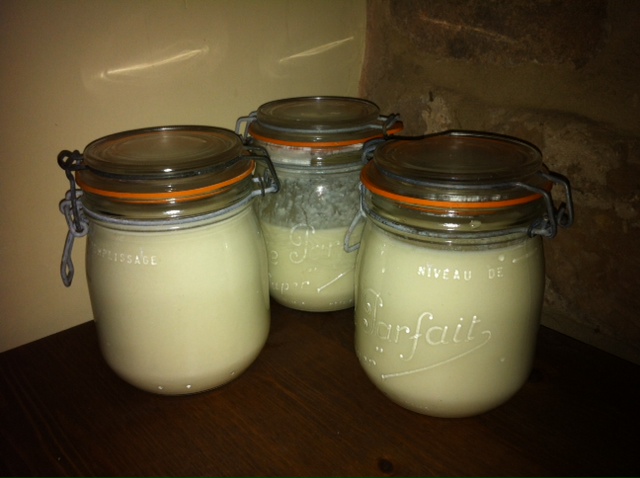
    I made yoghurt last night in the slow cooker. I found recipe and idea online and it was dead easy to do. I sieved it and bottled it up into 3 Kilner jars. The milk and the yoghurt starter I used were local and I used milk that was on its sell-by date and was reduced in Scaddows farm shop.

    Here's the recipe which was provided by http://www.blottedcopybook.co.uk/the-good-life/

    You will need:
    A slow cooker
    Milk (I used a 2.2l jug of semi-skimmed)
    Optional: One cup dried milk powder
    A small pot of plain live yoghurt (you need this as a “starter”)
    Storage for your home-made yoghurt.
    One word of advice – there are long periods of leaving things to work while you’re making yoghurt. Personally, being a bit of an old fart I don’t like pottering around in the kitchen late at night so leave five hours before you go to bed to start this off. I wouldn’t kick this off any later than 5pm at night.
    Before you start, make sure you have appropriate storage for your yoghurt. I sterilised a few 1l kilner-type jars (available from Ikea for 89p each or Lakeland for £14.99 per half dozen) and since we expect to use this yoghurt quickly this size of jar works well for us. I wouldn’t sterilise your storage until about an hour before your yoghurt will be finished.
    Take out your slow cooker (I have a Morphy Richards 6.5l one which I’ve found here for £29.99) and turn it on to the low setting. Pour your milk in (if you’re using milk powder add that now & whisk), pop the lid on and leave it for three hours.
    After the three hours, switch your slow cooker off. Take your pot of natural yoghurt – this will be your starter – out of the fridge and leave the yoghurt and milk for a further two hours.
    After two hours, add your yoghurt into the milk working quickly so as not to cool the milk down too much. Replace the lid of the slow cooker and cover the slow cooker with towels then leave it overnight for a minimum of eight hours.
    When you wake up, sterilise your jars and allow them to cool before adding the yoghurt – you don’t want to kill off the good bacteria, not least because if you want to make yoghurt again then you’ll need a decent cupful of this stuff as the starter for your next batch! This will safely keep in the fridge for a week or so.